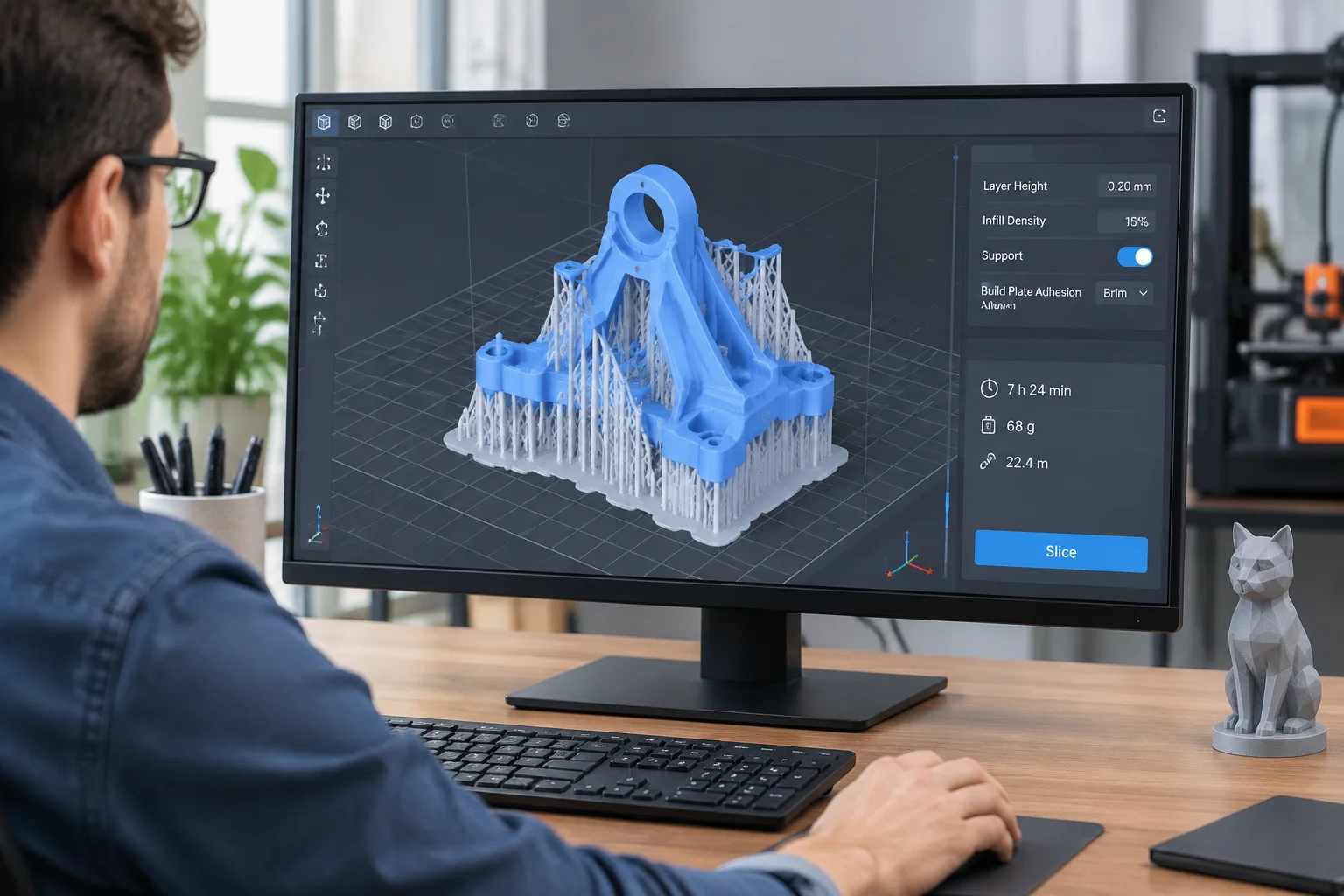
Evaluating modern hardware-accelerated slicing viewports: how explicit memory management and multi-threaded command buffers handle multi-million poly STL arrays without viewport latency.
Camina Drummer2026-11-058 min read
GPU memory allocation profiling and compute dispatch testing on multi-geometry trays
01
Overcoming Legacy Viewport Bottlenecks in Desktop Slicers
For nearly two decades, desktop slicing environments relied heavily on legacy OpenGL pipelines to display high-resolution faceted meshes. While satisfactory for singular parts, placing an entire build plate of forty dental bridges, microfluidic chips, or organic figurines quickly crippled rendering performance. Each individual support structure, strut cross-section, and contact point often generated separate draw calls. Consequently, CPU threads stalled waiting on implicit driver synchronization rather than feeding raw geometry to the GPU hardware.
The shift to modern low-level APIs like Vulkan completely reconfigures this relationship. By exposing explicit device memory allocation, specialized pipeline states, and multi-threaded command recording, modern slicers circumvent driver guesswork. Compute queues can process mesh boolean validation on one thread while graphics queues concurrently rasterize viewport shadows, overhang heatmap indicators, and real-time support pillar manipulation at steady 60 Hz refresh rates.
Direct control over GPU descriptor sets allows us to render millions of support truss segments through instanced indirect draw calls, eliminating the main-thread stutter that previously plagued complex SLA job preparations.
Multi-Threaded Command Buffers and Instanced Geometries
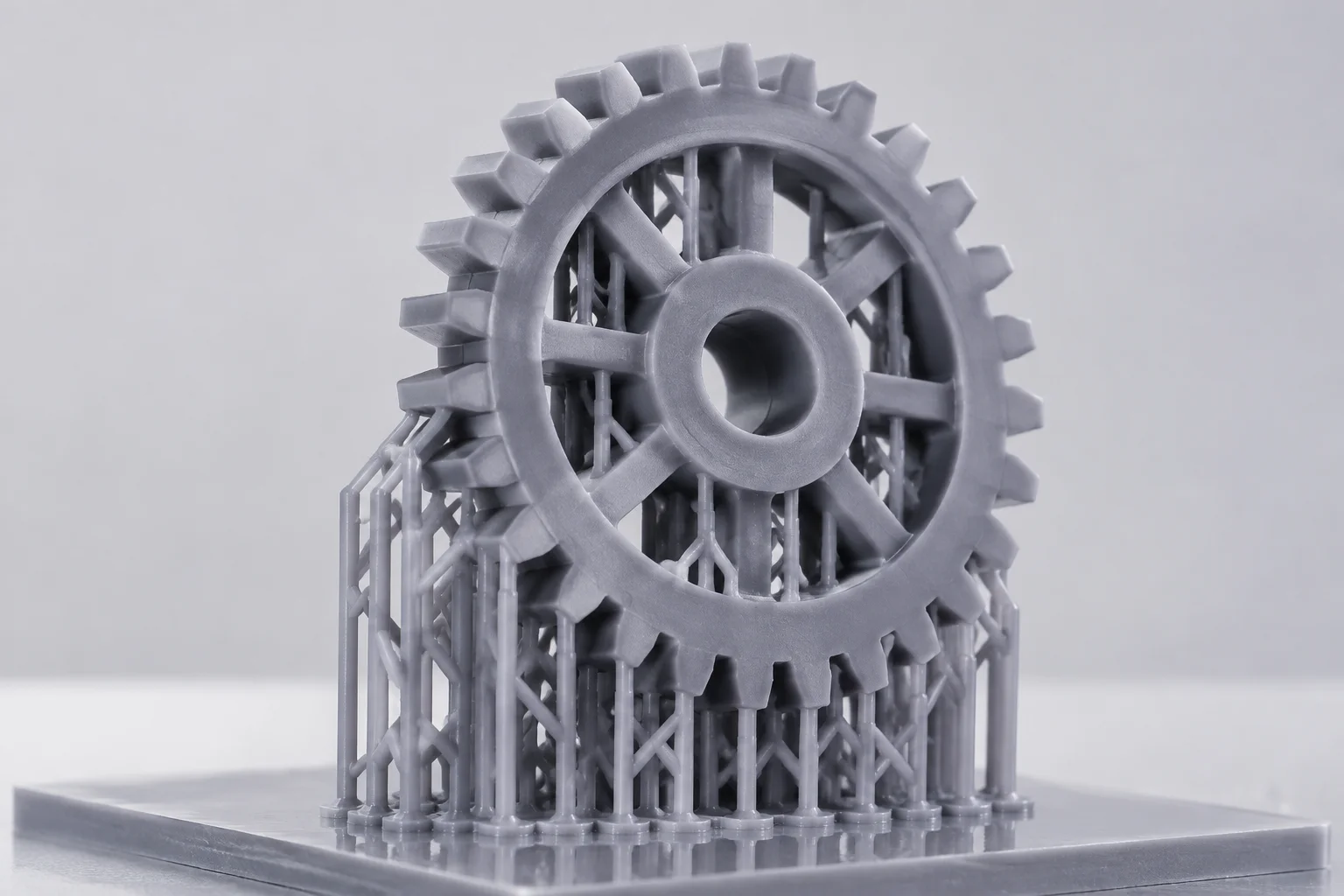
In an SLA build layout, support pillars are fundamentally composed of repeating primitives: base footings, vertical truss shafts, angled gussets, and tapered contact tips. In older graphics architectures, submitting thousands of these distinct components forced massive CPU context switching. Vulkan mitigates this bottleneck through several fundamental features:
Multi-threaded secondary command buffers that assemble complex support tree geometries across all available CPU cores simultaneously without locking.
Hardware instancing and dynamic buffer offsets for repetitive contact tips, minimizing GPU memory bandwidth and reducing draw overhead by over 80 percent.
Bindless texture and buffer arrays allowing instantaneous switching between surface slope shaders, island isolation views, and hollow shell previews.
03
Vulkan Compute Shaders in Real-Time Overhang & Island Detection
Beyond pure polygon rasterization, modern SLA workflow software utilizes Vulkan compute pipelines for analytical prep tasks. Identifying unsupported local minima (islands) on thirty-degree inclined surfaces previously mandated expensive CPU mesh traversal algorithms that froze the user interface during model rotation or scaling adjustments.
By dispatching parallel compute shaders directly against indexed triangle lists in VRAM, the engine calculates facet normals, z-axis height limits, and resin suction cup pockets in milliseconds. Technicians can now drag support pillars across complex freeform topologies and watch contact point stress warnings update interactively in real time.
04
Questions on Slicer Rendering Engines
No. Vulkan is a widely supported cross-vendor specification. It runs efficiently on integrated GPUs found in modern consumer laptops as well as high-end workstation cards, usually yielding better responsiveness on budget hardware than unoptimized OpenGL drivers.
While final slice rasterization to bitmap stacks depends largely on specialized 2D polygon clipping engines, Vulkan compute can parallelize contour rasterization and anti-aliasing passes, drastically cutting total job export time on multi-gigabyte build files.
Viewport display uses level-of-detail (LOD) approximations for smooth camera movement, but the underlying vector slicing pipeline always references the exact raw mesh vertex indices. Viewport LOD adjustments do not compromise final print precision.
Keywords:Vulkan EngineSlicing ViewportGPU Compute
Practical Engineering Utility
Assess Surface Defect Probability
Estimate peel force risks and support touchpoint requirements using our interactive engineering matrices.